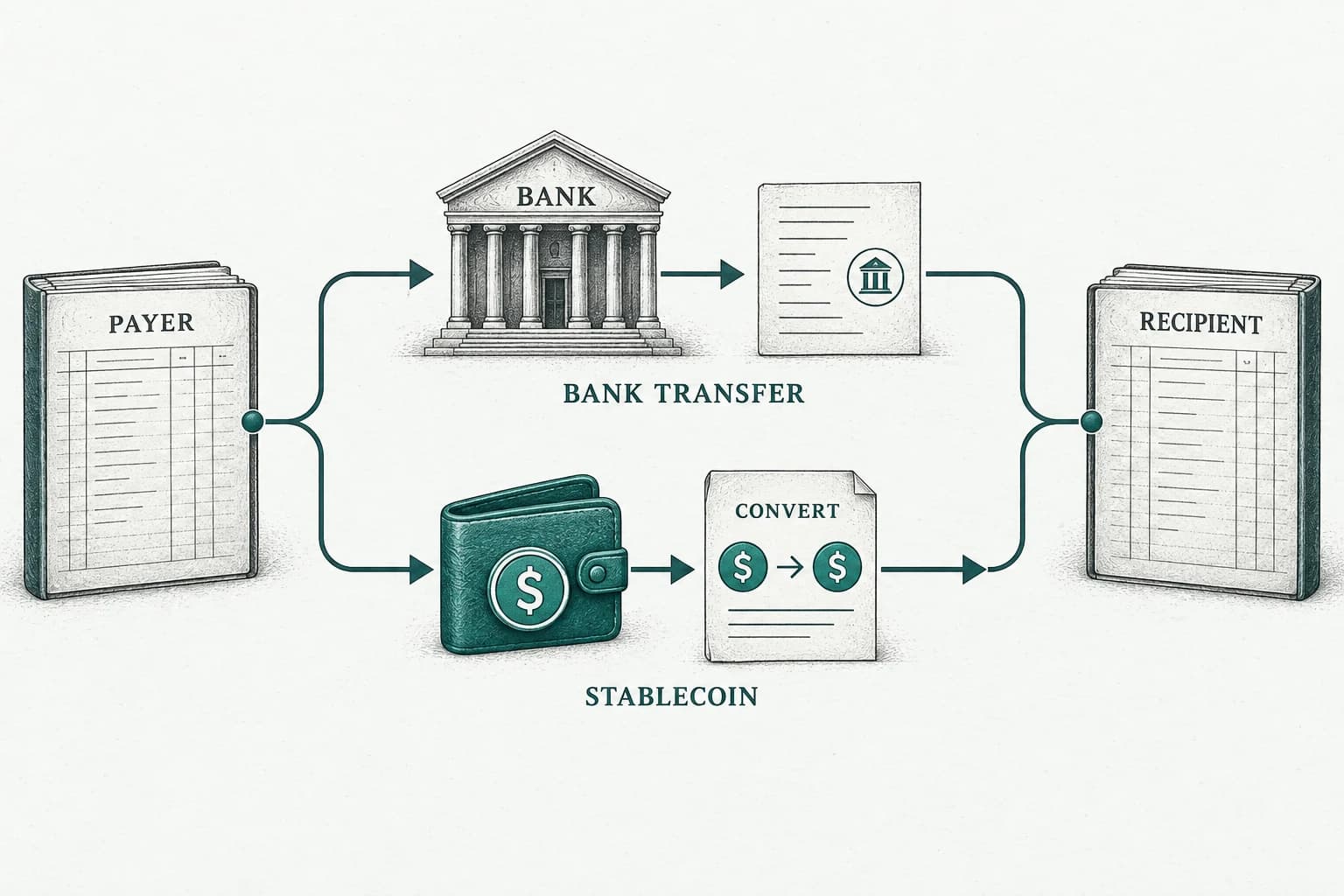
Stablecoins and bank transfers solve overlapping but different business-payment problems. A well-designed stablecoin route may operate continuously and transfer a digital claim quickly, but the business must still manage issuer, reserve, custody, wallet, network, compliance, liquidity, conversion, accounting, and legal risks. Bank transfers use established accounts, controls, and reporting, yet may involve cut-offs, intermediaries, opaque fees, or slower cross-border delivery. SMEs should compare the complete cash-to-cash journey—not the on-chain transfer alone—and use only providers and structures permitted in every relevant jurisdiction.
Begin with the payment outcome
Define what success means before choosing a rail. Identify the payer entity, recipient, countries, currencies, amount, urgency, purpose, frequency, required documentation, and form of money the recipient needs. A supplier may accept a token but still need local bank money for payroll. A treasury may value weekend transfer but not if conversion liquidity is unavailable. A fast network step can coexist with slow onboarding, funding, screening, redemption, or reconciliation.
Separate payment from speculation. A business-payment policy should not depend on an expected token price. Stablecoins aim to maintain a reference value, commonly against a fiat currency, but stability mechanisms and legal claims differ. The BIS has noted that by value the overwhelming majority of fiat-referenced stablecoins are linked to the US dollar and that much activity remains associated with crypto trading. That context should caution an SME against assuming every product is designed or regulated as business money.
Understand the stablecoin journey
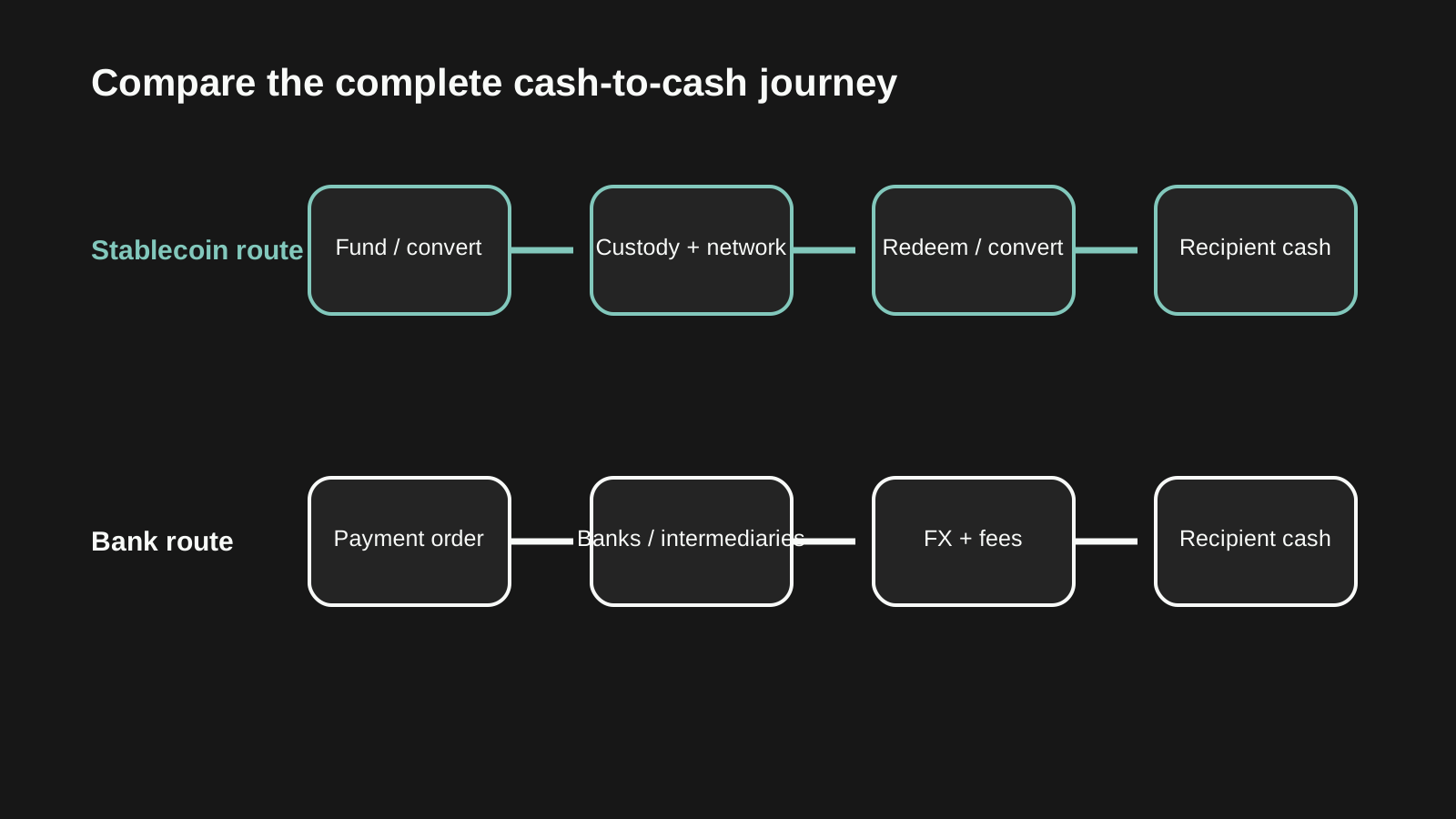
Map how the company obtains the token, who holds keys or controls the wallet, which network is used, how the recipient receives and verifies it, and how either party redeems or converts it. Identify every provider and jurisdiction. Fees can arise at funding, trading, spread, network, custody, withdrawal, redemption, and local conversion. Availability may depend on banking partners or liquidity venues even when the blockchain itself runs continuously.
Review the issuer’s legal structure, reserve disclosures, redemption terms, eligible customers, asset segregation, assurance, freeze or blacklist powers, and failure process. A token that shares a reference currency is not identical to a deposit at a regulated bank or to another stablecoin. Determine what claim the holder has and against whom. Obtain qualified legal and accounting advice; classification, tax, consumer, payments, sanctions, and reporting rules differ and continue to evolve.
Understand the bank-transfer journey
Bank payments also need full-path analysis. Domestic real-time systems may deliver funds quickly, while cross-border wires can pass through correspondent banks. Fees may be charged to sender, recipient, or both; foreign exchange may be embedded in a spread; compliance questions can delay release. Ask about cut-offs, value dates, tracking, cancellation, recall, repair, intermediary deductions, and the data delivered to each party.
The bank route’s strengths include familiar account ownership, established approval controls, statements, reconciliation feeds, and legal frameworks. Deposit protection, safeguarding, or finality rules vary and may not cover a business or full balance. A bank transfer can also be irrevocable after release, making fraud prevention essential. Familiarity should not be confused with zero risk; it means the risk model and operational responsibilities are usually better understood by finance teams.
Compare settlement, liquidity, and finality
A blockchain confirmation may be rapid, but business settlement is complete only when the intended recipient controls an asset it can lawfully and practically use. Consider network reorganization assumptions, issuer freeze rights, wallet controls, redemption windows, and conversion. For bank transfers, distinguish message status, account credit, usable balance, and legal finality. Ask what can still be reversed, frozen, recalled, or disputed at each stage.
Liquidity matters most during stress. Model the size of conversion relative to market depth, likely spread, operating hours of providers, redemption limits, and alternative routes. Do not hold more operational value in a rail than the risk policy permits merely to save transfer time. Establish maximum balances, approved tokens and networks, counterparties, and conversion time. Test a small complete transaction before relying on the route for a material obligation.
Build custody and transaction controls
Wallet security changes the control surface. Decide whether keys are held by a regulated custodian, multiple authorized devices, or another approved arrangement. Require strong authentication, role separation, address allowlists where supported, transaction limits, independent address verification, and recovery procedures. Protect seed phrases and signing devices from both theft and loss. Test access revocation when an employee leaves and continuity when an approver is unavailable.
Payment fraud controls still apply. Verify a new wallet address through an independently known channel, treat address changes like bank-detail changes, and watch for clipboard or malware substitution. Use a human-readable approval record containing beneficiary, amount, token, network, purpose, destination, fees, and expected recipient value. A transaction sent to the wrong valid address may be difficult or impossible to reverse.
Address compliance, accounting, and evidence
Screen parties and activity as required, document business purpose, and retain transaction identifiers and provider statements. Confirm that the token, service, exchange, custodian, and use are allowed for both parties. Cross-border transactions can touch multiple regulatory regimes even if the transfer feels borderless. Do not use a digital rail to bypass foreign-exchange, sanctions, tax, capital-control, licensing, or reporting obligations.
Define accounting policy for initial recognition, fees, valuation, gains or losses, impairment where applicable, and presentation. Reconcile wallet records to the ledger and preserve evidence linking an address to the approved counterparty. Public block explorers can show transactions but do not prove the commercial purpose or accounting owner. Keep invoice, authorization, rate source, transaction hash, provider confirmation, conversion, and recipient acknowledgment together.
Use a limited, reversible adoption path
Start with a permitted, low-value, non-urgent transaction and an established counterparty. Conduct provider due diligence, document the route, set limits, complete a sanctions and compliance assessment, and agree the recipient’s conversion process. Test normal transfer, rejection, delayed conversion, wrong-network prevention, access recovery, and accounting reconciliation. Run a tabletop exercise for issuer de-pegging, provider outage, frozen funds, lost credentials, and a fraudulent address request.
Review actual end-to-end time, recipient value, cost, manual work, failures, volatility, and control effort against the bank alternative. Continue only if the route solves a real business problem and remains within risk appetite. Maintain a bank fallback. Stablecoins may become useful infrastructure for specific corridors, programmable transactions, or round-the-clock operations, but an SME should adopt them as a controlled payment option—not as a shortcut around treasury discipline.
Set treasury reporting before volume grows. Show token balances by issuer, custodian, network, legal entity, and purpose; age unreconciled transfers; compare carrying value with redemption value; and monitor concentration against approved limits. Reconcile provider, wallet, and ledger records. Escalate price deviation, delayed redemption, provider restrictions, unusual fees, or control exceptions. A public market price is useful context but does not replace evidence of what the company can redeem, where, and under which terms.
Procurement and legal review should address service continuity, liability, transaction errors, data use, subcontractors, security incidents, dispute venue, termination, and export. Confirm whether the provider can change supported tokens, networks, fees, or customer eligibility without meaningful notice. Document who owns assets if the provider fails and how the business proves its claim. Marketing language about reserves or regulation should be traced to current legal documents and official registers.
Avoid false comparisons. A bank quote that includes conversion and recipient credit should not be compared with a blockchain fee that excludes purchase, spread, custody, redemption, and local payout. Conversely, a slow and expensive correspondent route should not be treated as the only bank option when regional instant systems or specialist regulated providers exist. Use the same amount, currency pair, time, recipient outcome, and control assumptions for every tested route.
Consider the recipient’s governance as part of the decision. A counterparty may use a personal wallet, an unapproved exchange, or an address controlled by one employee, creating risk even when the payer’s process is strong. Agree acceptable custody and evidence, legal-entity ownership, confirmation, and refund handling in advance. Do not pressure a smaller supplier to accept a rail it cannot control safely. A payment method creates shared operational responsibilities, and the commercial contract should reflect them.
Review the approval annually and after any issuer, custodian, network, regulation, accounting policy, or business-purpose change. Suspend new transfers while a material incident or de-pegging event is assessed. Treasury should have authority to move to the fallback rail without waiting for a routine committee cycle, while preserving the normal payment approval and verification controls.
| Factor | Stablecoin route | Bank-transfer route |
|---|---|---|
| Operating time | Network may run continuously; providers may not | Cut-offs and rails vary by country and service |
| Value stability | Depends on issuer, reserves, liquidity, and redemption | Account denomination is stable, while FX and bank risk remain |
| Control surface | Wallet, keys, token, network, issuer, conversion | Account access, approvals, bank, intermediaries, beneficiary data |
| Evidence | Wallet records plus commercial and provider documents | Statements, payment messages, invoices, and approvals |
| Failure response | Freeze, recovery, alternate custody and conversion plan | Recall, bank investigation, fallback rail and fraud response |
Frequently asked questions
Are stablecoin payments always faster than bank transfers?
No. The on-chain transfer may be fast, but onboarding, funding, screening, redemption, local conversion, or recipient operations can dominate total time. Compare the complete transaction from the payer’s usable cash to the recipient’s usable funds.
Is a stablecoin the same as money in a bank account?
No. Legal claims, reserve structures, redemption rights, protections, custody, and failure processes differ. Review the specific issuer and service rather than inferring safety from a stable reference price.
Should an SME hold stablecoins on its balance sheet?
That depends on business need, jurisdiction, accounting, tax, treasury policy, counterparty risk, and approved limits. Avoid holding operational value without a documented purpose, qualified advice, custody controls, liquidity plan, and fallback.
Sources
- Stablecoins and cross-border payments — Bank for International Settlements
- The next-generation monetary and financial system — Bank for International Settlements
- Cyber-enabled fraud: digitalisation and illicit-finance risks — Financial Action Task Force