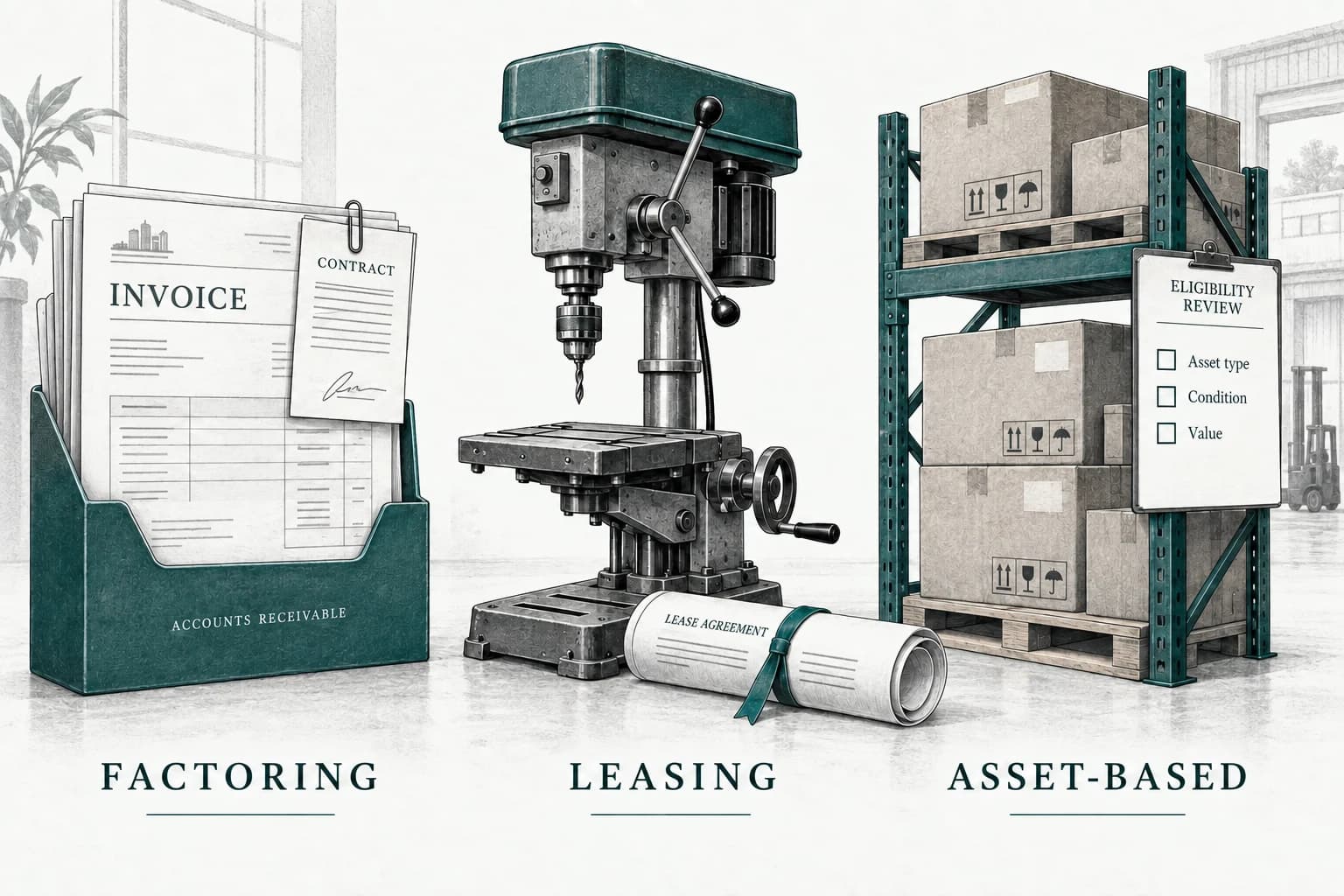
Factoring, leasing, and asset-based finance are not simply expensive substitutes for a bank loan. Each funds a different economic object: factoring advances cash against receivables, leasing provides the use of equipment, and asset-based lending sets a borrowing base against eligible assets such as receivables or inventory. They can improve liquidity and preserve bank capacity when structured well, but their true cost depends on fees, recourse, asset eligibility, controls, and what happens when customers pay late or asset values fall. SMEs should compare them against the same forecast and should obtain local legal, tax, and accounting advice before signing.
Why alternative instruments are moving into the mainstream
The OECD’s 2026 SME Finance Scoreboard describes continued diversification beyond conventional loans. Across reporting countries, factoring volumes fell by a median 3% in 2024 while leasing and hire-purchase volumes rose by 1.6%, but the direction varies substantially between markets. The larger point is that SMEs and providers are matching finance to observable assets and transactions. Digital invoicing, payment data, and connected accounting systems can make those assets easier to verify, even as economic volatility makes eligibility rules more important.
Alternative finance is most useful when it solves a defined timing or asset problem. A distributor waiting sixty days for strong customers may benefit from receivables finance. A manufacturer may prefer to lease machinery rather than use scarce cash upfront. A wholesaler with seasonal stock may use an asset-based line whose availability grows with eligible inventory. None of these structures creates profitability. They convert, fund, or provide access to an asset; the business still needs adequate margin, controls, and a credible path to cash.
Factoring: selling or financing receivables
In a factoring arrangement, a provider advances part of the value of approved invoices and collects or receives payment when the customer settles. The balance is remitted after fees and adjustments. With recourse, the SME generally remains responsible if the customer does not pay after an agreed period. Without recourse, specified credit risk may transfer to the factor, but disputes, dilution, fraud, or ineligible invoices can remain with the seller. The contract—not the marketing label—determines the allocation of risk.
Factoring can shorten the cash-conversion cycle and add disciplined collections, yet it can also affect customer experience and reporting. Verify whether customers are notified, who communicates about disputes, how credit limits are assigned, and how reserves change. Calculate cost against the actual advance and expected days outstanding, including service, audit, minimum-volume, concentration, and termination fees. If one customer represents a large share of receivables, a factor’s concentration cap may leave much less availability than the invoice total suggests.
Leasing: paying for productive use
Leasing can align payments with the period in which equipment produces value. The lessor owns or finances the asset while the SME makes scheduled payments, sometimes with maintenance, renewal, purchase, or return options. This can reduce the initial cash requirement and simplify upgrades. It does not automatically make the asset cheap. Compare the present value of payments, deposits, insurance, maintenance, taxes, end-of-term obligations, usage limits, and the cost of buying or financing an equivalent asset.
Operational fit is as important as price. A rapidly changing technology asset may justify flexibility at the end of the term, while long-lived specialized machinery may favor ownership. Confirm who bears installation, downtime, damage, obsolescence, and disposal risk. Accounting and tax treatment differ by jurisdiction and reporting framework, so the legal form of a lease may not determine its balance-sheet treatment. Management should model the economic cash flows and ask qualified advisers to confirm local reporting and tax consequences.
Asset-based lending: a borrowing base that moves
Asset-based lending usually provides a revolving facility based on eligible receivables, inventory, or sometimes equipment. The provider applies advance rates, exclusions, concentration limits, reserves, and reporting requirements to calculate availability. A nominal facility of one million may provide far less usable cash after aged invoices, related-party balances, overseas receivables, slow stock, or customer concentrations are excluded. Availability can also shrink just when trading weakens, because the collateral pool deteriorates.
That variability makes borrowing-base forecasting essential. Project eligible assets—not only total assets—alongside sales, collections, purchasing, returns, discounts, and seasonal patterns. Reconcile certificates to the ledger and assign ownership for exceptions. Understand inspection rights and field-audit costs. Asset-based finance can be powerful for a growing company with strong working-capital assets, but poor records, disputed invoices, obsolete inventory, or sudden reserve changes can turn an apparently generous line into a liquidity surprise.
Compare economics, control, and operational load
Convert each structure into a cash-flow model for a realistic period. Measure net funding received, timing of charges, required reserves, minimums, break costs, and internal administration. Then model operational events: a customer dispute, a large credit note, inventory aging, equipment failure, or a fall in sales. A provider’s quoted fee may look small as a percentage of invoice face value but become substantial when annualized over the advance period and calculated against the cash actually available.
Control terms deserve their own review. Providers may require lockbox accounts, direct customer payment, asset tags, insurance, regular reporting, audits, or approval before additional debt. Personal guarantees or broad security may extend beyond the financed asset. Data access may reach accounting platforms and bank feeds. Confirm how data is protected, which subcontractors process it, how authorization is revoked, and what happens to records after termination. These details affect resilience and bargaining power later.
A disciplined decision and monitoring process
Begin with the operating problem, not the product. Identify the asset, cash timing, maximum need, expected duration, and failure scenario. Shortlist regulated or otherwise credible providers that serve the relevant industry and jurisdiction. Request a full term sheet and sample calculation. Reconcile every assumption to the cash forecast and obtain legal advice on security, recourse, default, set-off, termination, and customer-notification clauses. Verify accounting and tax treatment independently where material.
After signing, monitor availability, effective cost, exceptions, disputes, customer concentration, covenant headroom, and forecast accuracy. Review whether the product still fits as the business changes. A firm that improves collections may need less factoring; a growing inventory base may justify a different facility; a stable balance sheet may qualify for lower-cost bank finance. Alternative finance should remain an intentional tool rather than a permanent process nobody has re-evaluated.
Watch the risks that sit outside the spreadsheet
Customer and supplier relationships can change when a financier becomes visible in the process. A factor’s collections style may affect an important account; a leased asset may be difficult to modify or relocate; a lender’s control over receipts may reduce flexibility during a dispute. Ask references about real servicing behavior, not only approval speed. Review complaint channels, system availability, statement clarity, and how quickly the provider resolves errors. Operational friction has a cost even when it never appears in the annualized percentage.
Legal priority and enforcement also matter. Search registrations, assignments of receivables, negative pledges, retention-of-title claims, and cross-defaults can interact with existing facilities. An SME should map every security interest and contractual restriction before adding another. Confirm what the provider can do after a missed report, covenant breach, disputed invoice, insurance lapse, or insolvency event. These are local legal questions, so obtain advice in each relevant jurisdiction rather than transferring assumptions from another country.
Data quality is the final recurring risk. Availability calculated from invoices or inventory can only be as reliable as customer master data, credit notes, goods movements, and aging logic. Reconcile provider reports to the general ledger, investigate adjustments promptly, and restrict who can change master records. Strong operations can make alternative finance flexible; weak records can make the same structure unpredictable and expensive.
Plan the exit in cash terms. Model the final collection, asset return or purchase option, termination notice, release of security, data export, and replacement funding. Confirm how reserves are returned and how long customer payments may continue through controlled accounts. An attractive entry price can be offset by an unclear or costly exit. Put notice dates and renewal windows into the finance calendar so management can negotiate while alternatives remain available.
Board reporting should distinguish gross facility size from current usable availability. Show utilization, unused headroom, effective cost, exceptions, collateral concentration, and the next renewal decision each month. If the product is funding losses rather than a temporary working-capital cycle or productive asset, escalate the underlying operating issue instead of assuming a larger facility will solve it.
| Instrument | Economic object | Questions to answer |
|---|---|---|
| Factoring | Approved customer receivables | Recourse, notice, reserves, concentration, and dispute treatment |
| Leasing | Use of equipment or other productive assets | Total payments, maintenance, damage, flexibility, and end-of-term options |
| Asset-based lending | A changing pool of eligible receivables or inventory | Advance rates, exclusions, audits, reserves, and shrinking availability |
| Conventional term loan | General creditworthiness and repayment cash flow | Rate, tenor, covenants, security, and amortization fit |
Frequently asked questions
Is invoice factoring the same as taking a loan?
Not always. Some arrangements involve the sale of receivables, while others are economically closer to secured finance. Recourse, control, and accounting treatment vary. Read the contract and obtain jurisdiction-specific accounting and legal advice rather than relying on the product name.
Does leasing keep debt off the balance sheet?
Do not assume so. Recognition depends on the reporting framework, contract terms, and applicable local rules. Even when presentation differs, management should include the full payment obligation in cash planning and financing decisions.
When is asset-based finance unsuitable?
It may be unsuitable when assets are hard to verify, receivables are concentrated or disputed, inventory becomes obsolete quickly, reporting systems are weak, or fluctuating availability would make liquidity less predictable. A forecast using eligibility rules is essential before commitment.
Sources
- Financing SMEs and Entrepreneurs 2026: An OECD Scoreboard — OECD
- Annual Economic Report 2026 — Bank for International Settlements
- Tax Administration Digitalisation and Digital Transformation Initiatives — OECD