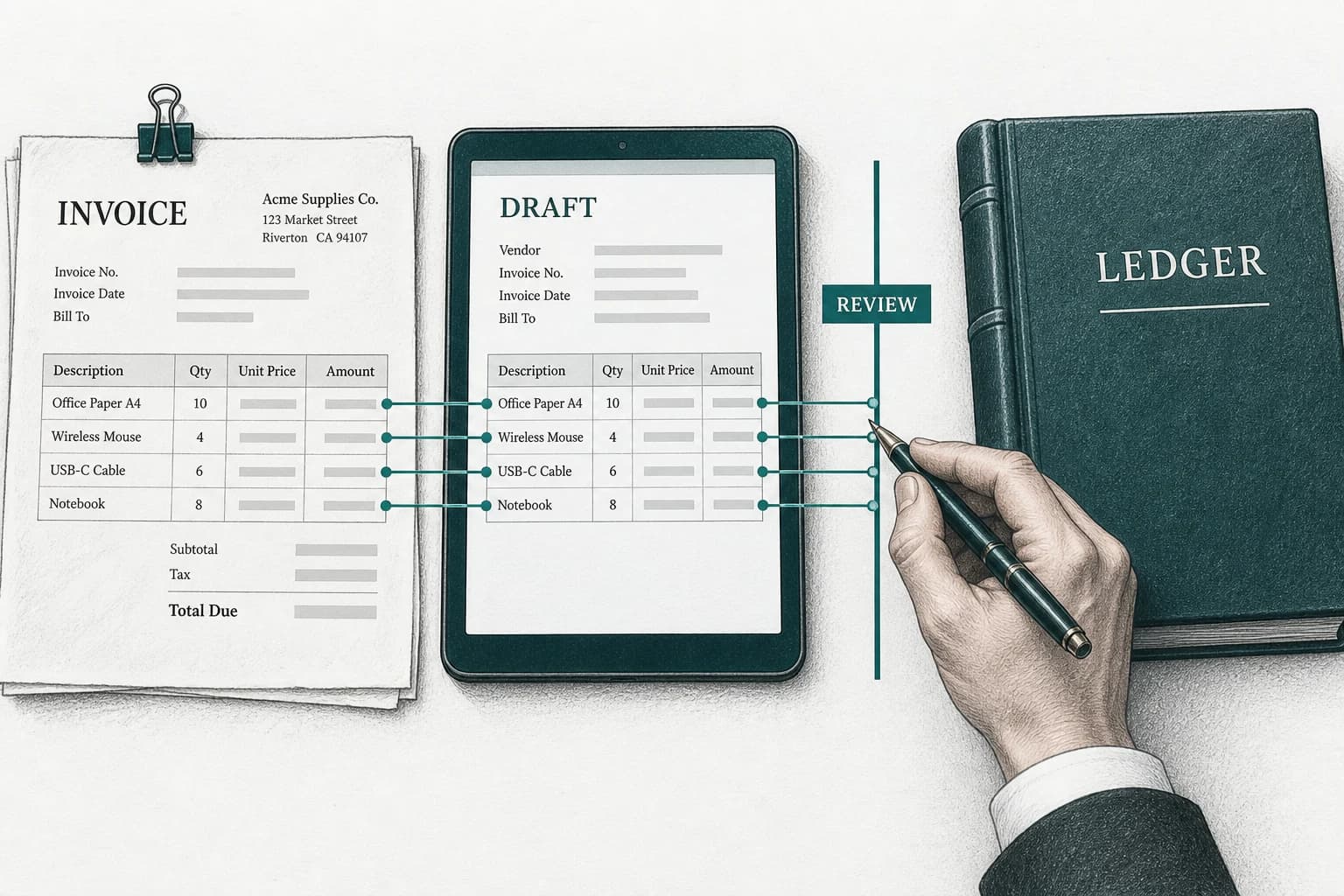
SME finance teams should automate high-volume, reversible work where inputs and expected outputs are observable—such as document classification, transaction suggestions, variance triage, and first-draft commentary. They should keep accountable human control over payments, journal posting, access changes, accounting estimates, tax positions, external reporting, and any decision whose error could materially harm the company. The safest pattern is assist, verify, approve, record: AI proposes or summarizes; a named person checks evidence and authority; controlled systems execute; logs preserve what happened.
Choose work by risk and observability
A task is a promising automation candidate when it is frequent, rules or examples are available, the source data is permitted, output can be checked, and a mistake is easy to reverse. Classifying invoices, matching remittance references, extracting contract dates, drafting a management-report narrative, or highlighting unusual movements may fit. A task is less suitable when policy is ambiguous, evidence is incomplete, the consequence is material, or the system would act before a responsible person can review it.
Separate language-model capabilities from deterministic accounting logic. A model can summarize a variance explanation, but the ledger calculation should come from controlled records. It can propose an account code, while posting rules and approval thresholds remain explicit. It can retrieve a policy, but it should not silently invent one. This division makes testing possible and reduces the chance that persuasive language is mistaken for reliable accounting evidence.
Protect data before testing convenience
Finance data can contain bank details, payroll, tax identifiers, contracts, personal information, and commercially sensitive results. Before using any AI service, identify what data leaves the company, where it is processed, how long it is retained, whether prompts or outputs train shared models, which subprocessors are involved, and how access is revoked. Use approved accounts rather than personal tools. Minimize fields, mask data where practical, and avoid production records in experiments unless governance explicitly permits them.
Connectors deserve particular scrutiny. An assistant with read access to email, storage, accounting, and banking may combine information in ways no single application could. Give the least privilege for the shortest useful time, separate read from write, and require explicit confirmation for external actions. Log connector calls and test what happens when a prompt contains malicious or misleading instructions from an invoice, email, or document. The convenience of one connected interface must not erase existing segregation of duties.
Design approvals around the consequence
Use tiered authority. Low-risk suggestions may be accepted during normal processing; medium-risk exceptions may require a trained reviewer; material journals, payments, vendor-master changes, tax decisions, and published reports should follow established approvals regardless of whether AI was involved. Do not let the person who configured an automation become its only approver. Bank release controls, dual authorization, and supplier verification should remain independent of the model and its interface.
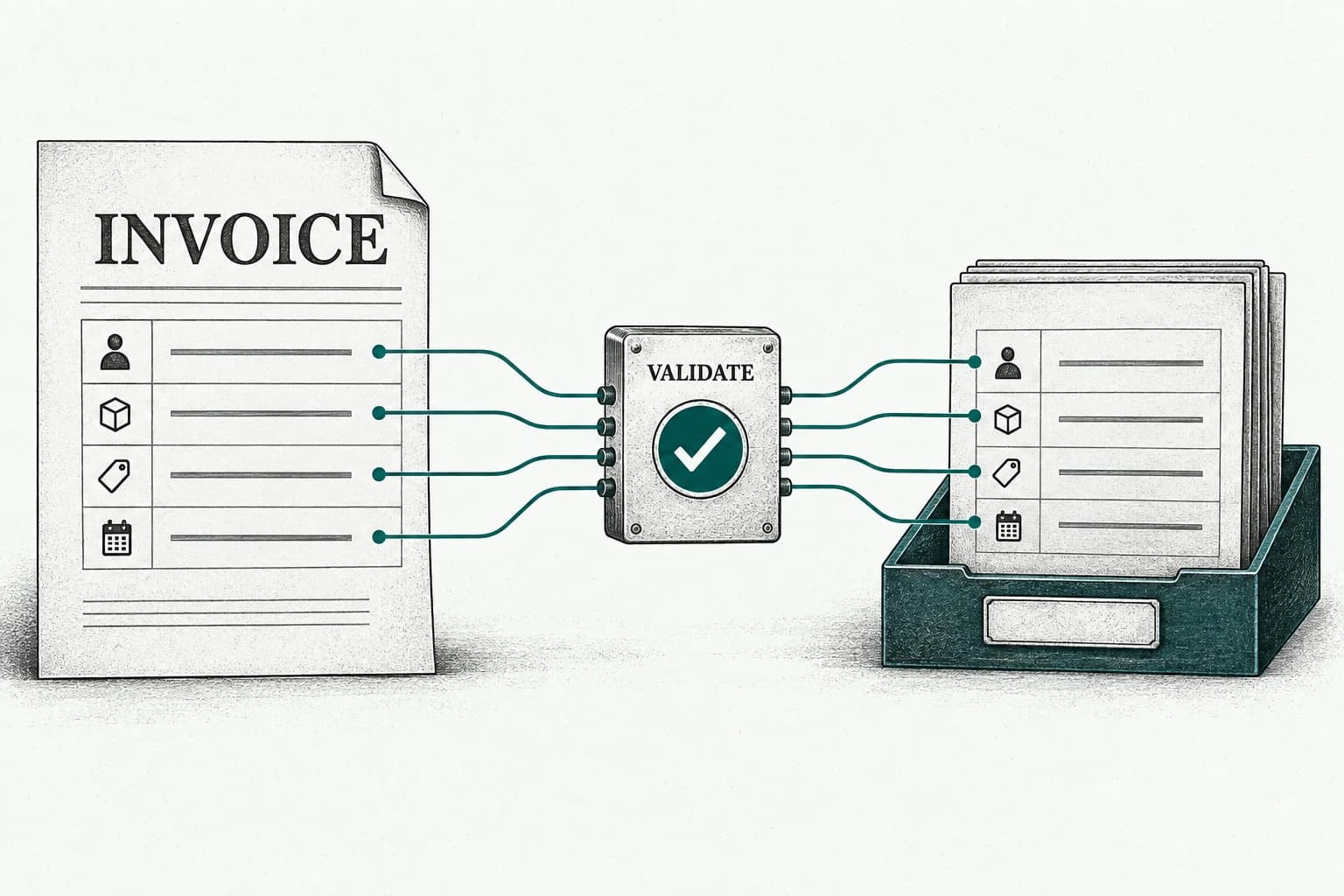
Define what the reviewer must check. A vague instruction to apply judgment produces inconsistent assurance. For invoice extraction, check supplier identity, purchase authorization, amount, tax, bank details, duplicates, and supporting evidence. For a report narrative, reconcile every stated number, label uncertainty, remove unsupported causes, and confirm the audience. The approval record should identify the version, input evidence, reviewer, time, and outcome. That evidence supports investigation and improvement when something goes wrong.
Test with a finance-grade evaluation set
Create representative, permitted examples covering normal work and difficult edges: credit notes, multiple currencies, poor scans, duplicate invoices, unusual tax treatment, conflicting documents, prompt injection, and missing approvals. Establish expected outputs with experienced finance staff. Measure extraction accuracy, false matches, missed anomalies, unsupported statements, latency, cost, and reviewer effort. A high average score can hide dangerous failure on a small but material category.
Run the tool in shadow mode before execution. Compare its suggestions with the existing process without allowing it to post, pay, or communicate. Investigate disagreements rather than treating the incumbent process as automatically correct. Set acceptance thresholds by consequence and define fallback behavior when confidence is low or a dependency fails. Retest after a model, prompt, connector, workflow, policy, or source-system change. AI performance is not a one-time certification.
Keep evidence, monitoring, and incident response
Record the model or service version, relevant configuration, input references, output, reviewer decision, and downstream action without creating unnecessary copies of sensitive data. Monitor override rates, recurring error categories, drift, access changes, data leakage indicators, vendor incidents, and cost. If reviewers routinely correct one supplier or transaction type, route it differently or improve the source process. If staff accept suggestions without examining them, the control has become ceremonial.
Prepare an AI-specific incident path that fits the company’s wider response plan. Know how to disable a connector, rotate credentials, stop an automation, preserve logs, identify affected transactions, and notify responsible leaders. For payment or vendor-master workflows, connect the path to fraud response and bank contacts. Practice at least a tabletop scenario: a malicious invoice causes an unsafe suggestion, a model exposes information to the wrong user, or an automated narrative publishes an unsupported claim.
Measure business value without hiding control cost
Track end-to-end cycle time, correction rate, backlog, exception resolution, close duration, forecast accuracy, control findings, and employee effort—not only tokens or tasks processed. Include implementation, integration, testing, supervision, vendor, security, and change-management costs. A tool that drafts in seconds but requires extensive correction may not create value. A tool that removes tedious sorting and lets experienced staff investigate exceptions may improve both throughput and work quality.
Scale only after the owner, objective, allowed data, decision boundary, evaluation, approval, monitoring, fallback, and exit plan are documented. NIST’s AI Risk Management Framework organizes this discipline through Govern, Map, Measure, and Manage. An SME does not need a large committee to apply the logic. It needs visible accountability and a repeatable record showing why the use case exists, what can go wrong, how output is checked, and who can stop it.
Manage vendors and change as part of the control
Vendor due diligence should cover more than feature demonstrations. Review contractual responsibility, service availability, security assurance, data location, subprocessors, model changes, deletion, export, incident notification, intellectual-property terms, and the right to terminate. Understand whether the product uses one model or routes prompts among providers. Confirm how administrators see usage and whether the company can restrict connectors, retention, sharing, and high-risk functions. Record which assurances are independent and current rather than accepting a general claim of enterprise readiness.
Design an exit before dependency grows. Keep authoritative finance records in controlled systems, preserve prompts or configurations needed for continuity, and avoid workflows that only one vendor can interpret. If a service is unavailable, staff should know how invoices, reconciliations, close activities, or reports continue. If the company changes providers, it should be able to export relevant records and revoke every token and integration. Resilience includes the ability to operate safely without the AI layer.
Change management is equally practical. Tell staff what the tool does, which data is allowed, when output needs challenge, and how to report a problem without blame. Train reviewers on recurring failure patterns and automation bias. Update process narratives, risk registers, access reviews, and control evidence. Do not quietly add capabilities because a vendor enabled them by default. A new model or connector can change the risk boundary even if the screen looks the same.
Senior leaders should review a small portfolio of approved use cases rather than an uncontrolled collection of experiments. For each, see the objective, owner, risk tier, data, measured benefit, exceptions, incidents, cost, and next review date. Retire tools that do not create verified value. This portfolio discipline keeps AI aligned with the finance function’s real purpose: reliable information, protected assets, compliant processes, and better decisions.
Regional requirements can alter the implementation. Data-protection, employment, financial-reporting, tax, record-retention, and sector rules differ, and cross-border processing may add obligations. Map affected jurisdictions and obtain specialist advice for material uses. A global vendor configuration should not be treated as proof that one workflow is appropriate everywhere the SME operates.
Start with one controlled workflow and a defined evaluation window. Publish what success and failure mean before results arrive. At the end, compare outcomes with the prior process, review incidents and near misses, and decide to stop, revise, or expand. A deliberately small pilot with honest evidence is more useful than a broad launch that creates activity without accountable, measurable, durable improvement for the finance team.
| Use case | AI may assist with | Human or deterministic control |
|---|---|---|
| Invoice processing | Extraction, classification, duplicate signals | Supplier validation, approval, posting, payment release |
| Reconciliation | Candidate matches and exception grouping | Balance ownership, unresolved-item judgment, sign-off |
| Management reporting | Draft narrative and question generation | Number reconciliation, cause verification, publication |
| Forecasting | Pattern suggestions and scenario prompts | Assumptions, overrides, decisions, accountability |
| Tax and external reporting | Retrieval and working-paper organization | Technical position, filing, representation, adviser review |
Frequently asked questions
Can AI post accounting entries automatically?
Technically it can, but the decision should depend on risk. For SMEs, start with suggestions and controlled approvals. If low-risk repetitive entries later qualify for straight-through processing, retain deterministic rules, thresholds, exception routing, audit evidence, and independent monitoring.
May staff paste finance data into a public AI tool?
Only if the organization has explicitly approved the service, account, data category, retention, processing terms, and use case. As a default, do not place confidential, personal, banking, payroll, customer, or tax data into unapproved tools.
Who owns an AI finance control?
Assign a business owner accountable for the outcome, a process or control owner for operation, and technical and security owners for the system. The finance leader remains accountable for finance decisions even when a vendor or model contributes to the workflow.
Sources
- Artificial Intelligence Risk Management Framework — National Institute of Standards and Technology
- Tax Administration Digitalisation and Digital Transformation Initiatives — OECD
- Annual Economic Report 2026 — Bank for International Settlements