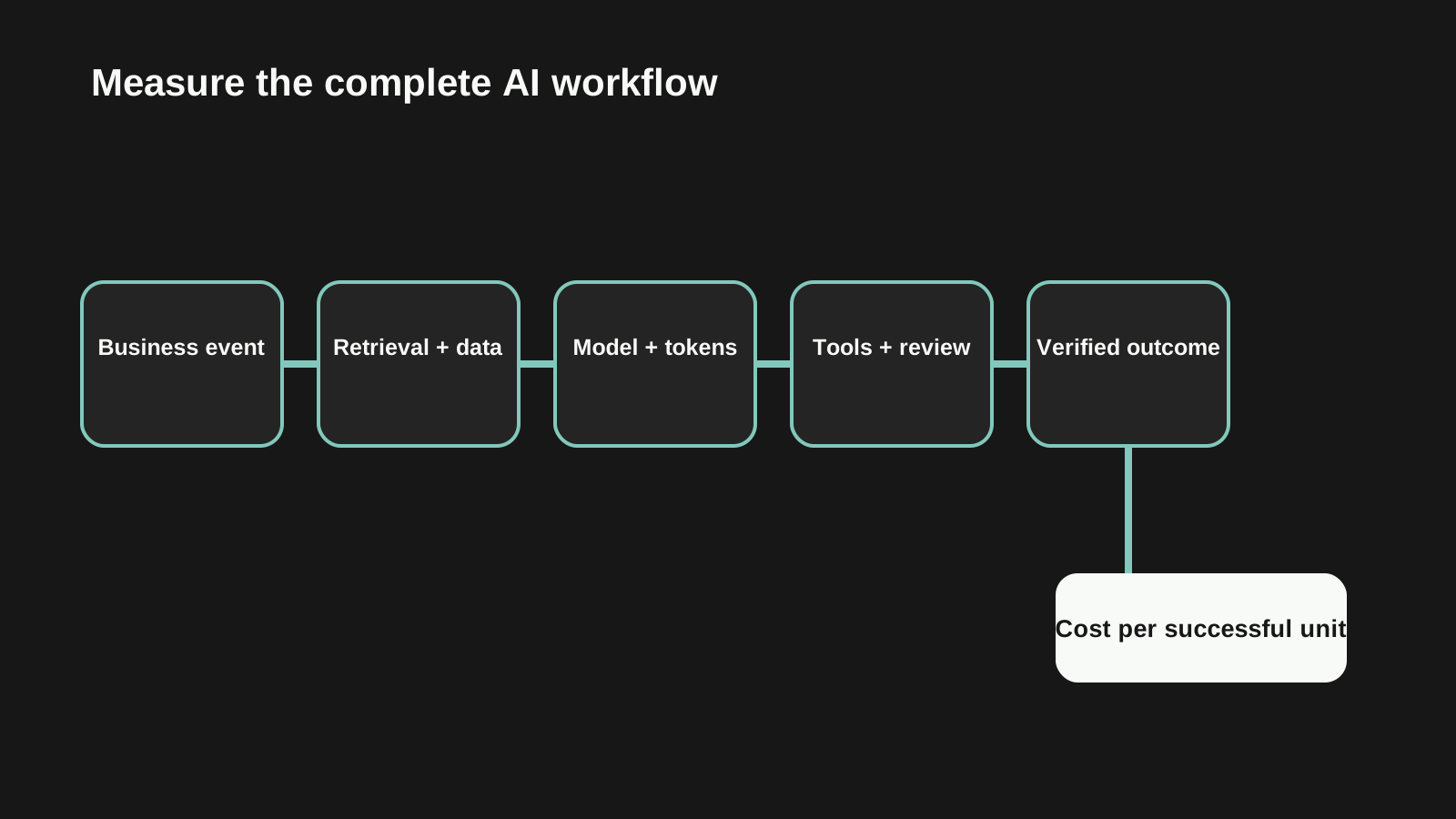
Apply FinOps to AI by making every production use identifiable, allocatable, budgeted, observable, and tied to a business outcome. Measure the full workflow cost—model input and output, cached tokens, embeddings, retrieval, vector storage, tools, compute, network, observability, guardrails, evaluation, and human review. Define a unit such as cost per resolved case or approved document, with a quality and safety threshold. Then optimize demand, prompts, context, model routing, caching, batching, architecture, and process before negotiating price or cutting controls.
Why AI economics differ from ordinary cloud
AI combines usage-based model charges with familiar cloud, data, and labor costs. Consumption can be driven by user prompts, automated agents, long context, retries, tool loops, evaluations, and background indexing. A small feature can create variable spend without a visible server. The FinOps Foundation’s 2026 survey covers 1,192 respondents associated with about $83 billion in cloud spend and reports that 98% manage or plan to manage AI costs, showing how quickly the scope is joining mainstream technology economics.
Cost is also coupled with quality. A cheaper model may require more retries or human correction; shorter context may omit necessary evidence; removing evaluation may hide failure. FinOps for AI should optimize verified business value, not tokens in isolation. Define the service objective and acceptable outcome before selecting a model or commitment. Otherwise, teams can celebrate lower unit price while the end-to-end workflow becomes slower or less reliable.
Build a complete cost map
Inventory providers, accounts, projects, models, regions, rates, commitments, quotas, and data services. Tag or otherwise attribute calls to application, environment, team, feature, customer or tenant where appropriate, workflow, and owner. Include input, output, cached and reasoning units where pricing distinguishes them; embeddings; image, audio, or video generation; retrieval; storage; databases; functions; gateways; network; logs; security; and vendor platform fees.
Add people and risk cost. Data preparation, prompt design, integration, evaluation, review, corrections, incident response, procurement, and governance are part of the product economics. Avoid allocating confidential customer content into billing labels. Reconcile provider usage with internal telemetry and finance invoices. Record rate and currency dates so trend changes are not mistaken for engineering changes.
Define units that connect to business value
Choose a denominator the business recognizes: qualified lead brief, support case resolved, invoice reviewed, contract clause extracted and approved, report drafted and accepted, or developer change merged with tests. Track cost per attempted and successful unit, quality, time, correction, escalation, and customer outcome. A cost per chat tells little if chats vary in complexity and none correspond to a completed task.
Establish baseline cost and outcome for the prior process. Attribute shared platform cost through a documented rule and show uncertainty. Segment by workload because an easy FAQ and a complex investigation should not share one target. Report percentiles, not only averages, to reveal long or looping requests. Unit economics should support a decision: continue, redesign, route, limit, price, or stop.
Control demand before optimizing supply
Require an approved use case and owner before production credentials. Set project budgets, rate limits, concurrency, maximum context and output, agent step limits, timeouts, and user quotas suited to the workflow. Detect retries, duplicate requests, runaway loops, abusive traffic, and unused experiments. Separate development and production and expire test keys. Show users when an expensive action starts and require confirmation where appropriate.
Reduce unnecessary calls through deterministic code, search, templates, validation, and ordinary product design. Do not ask a model to calculate a known formula, re-read unchanged context, or generate text nobody uses. Batch offline work where service requirements allow. Cache stable permitted results with clear invalidation and privacy boundaries. Archive or remove unused embeddings and logs under retention policy.
Optimize prompts, context, models, and routing
Measure context composition and remove duplicated instructions, irrelevant history, oversized tool descriptions, and low-value retrieved documents. Use structured output to reduce repair. Summarize carefully with provenance and test whether compression loses needed facts. Improve retrieval quality so fewer relevant passages outperform a large indiscriminate context. Evaluate prompt changes against quality, safety, latency, and cost together.
Route workloads to the least costly model that meets the threshold. Use deterministic rules or a small model for classification and a stronger model for complex cases, with escalation. Compare hosted and self-managed economics only after including operations, utilization, hardware, energy, availability, security, upgrades, and staff. Commitments or volume discounts make sense only after demand is understood and portable enough to avoid expensive lock-in.
Create forecasts, anomaly controls, and accountability
Forecast from business drivers such as active users, cases, documents, average calls, token distribution, success, and growth. Add model-price, currency, product-mix, and retry scenarios. Define forecast owner and review variance monthly or more often for fast-changing workloads. Alerts should identify unusual cost per unit, volume, output length, failure, retry, agent steps, region, customer, or credential—not merely a high total bill.
Give engineers timely usage visibility and business owners outcome visibility. Finance should reconcile invoices and commitments. Leaders should see spend, unit economics, quality, value, forecast, and risks by portfolio. Avoid incentives that push teams to hide usage or skip evaluation. Chargeback or showback should be understandable, stable, and open to correction. Shared accountability works better than a central team policing every prompt.
Run a quality-aware optimization cycle
Prioritize the largest cost pools and highest variance, propose a change, run an evaluation, deploy gradually, and compare unit cost and outcome. Keep a change log and rollback. Review whether savings persist after traffic and behavior adapt. Optimize architecture and product workflow before removing controls. A blocked unsafe action may add cost but prevent far greater harm.
Quarterly, review every use for owner, purpose, users, business value, spend, quality, incidents, portability, and next decision. Retire redundant models and dormant indexes, revoke credentials, and release unused commitments where possible. FinOps is a continuous operating practice, not a one-time cost-cutting exercise. The objective is to fund the AI work that creates verified value and stop the work that produces consumption without accountable outcomes.
Control experimentation without preventing it. Give teams isolated budgets, approved models, synthetic or permitted data, expiration dates, and a path to production review. Label non-production resources and delete them on schedule. Successful prototypes should present measured demand, quality, security, architecture, and unit economics before receiving production credentials. Failed experiments should release resources and document useful learning.
Segment cost by customer carefully. Some products need tenant-level allocation for pricing or abuse control, but labels, logs, and dashboards must not expose confidential prompts or personal data. Use opaque identifiers and access controls. Define how shared retrieval, caches, evaluations, and platform work are allocated. Explain the method to finance and product leaders and avoid false precision where attribution is estimated.
Include sustainability and capacity where relevant. Model inference and infrastructure consume energy and scarce hardware, but public estimates may not match a specific provider or workload. Prefer provider-specific evidence where available, reduce waste through the same demand and architecture controls, and avoid unsupported environmental claims. Efficiency can improve cost, latency, and resource use simultaneously without pretending that tokens are a complete impact measure.
Plan procurement with engineering. Compare rate cards, context and output rules, batch and cache pricing, commitments, regional availability, data terms, service levels, portability, observability, and support. Test invoices against telemetry before signing a long commitment. Retain leverage by separating business logic from one model interface and by maintaining evaluations that make an alternative provider measurable rather than hypothetical.
Manage logs as a cost and risk surface. High-volume prompts, responses, traces, and tool payloads can create storage, indexing, and privacy expense. Log the minimum evidence needed for operations, security, evaluation, and audit; redact secrets; tier retention; and restrict search. Sampling may suit routine diagnostics, while consequential actions need complete traceability. Validate that reducing logs does not undermine incident investigation.
Use budgets as decision signals, not automatic service failures. A hard cap can protect an experiment, while a critical customer workflow may need graceful degradation, routing to a cheaper model, reduced optional features, or controlled human fallback. Define behavior before the limit is reached and alert owners early. Never let a cost-control mechanism silently remove safety checks or corrupt an in-progress business transaction.
Close the loop with pricing and capacity planning. If AI cost varies materially by customer or request, product leaders need fair-use rules, feature limits, or pricing that reflects service cost without hiding surprise charges. Sales forecasts should translate into infrastructure and model demand. Finance, product, and engineering should approve the assumptions together and revisit them as behavior changes.
| Layer | Metric examples | Decision supported |
|---|---|---|
| Consumption | Calls, tokens, embeddings, tool steps, compute | Where is demand created? |
| Cost | Provider, infrastructure, labor, review, shared allocation | What is the complete spend? |
| Unit economics | Cost per attempted and successful business event | Which workflow or segment is viable? |
| Quality and risk | Accuracy, correction, escalation, incident, latency | Does optimization preserve the threshold? |
| Value | Time, capacity, revenue, service, or control outcome | Should the use expand, change, or stop? |
Frequently asked questions
Is token cost the same as AI product cost?
No. Token charges are one component. Include retrieval, storage, tools, compute, observability, security, evaluation, integration, support, human review, correction, and governance to understand the product economics.
Should every request use the cheapest model?
No. Use the least costly architecture that meets the defined quality, safety, latency, and reliability threshold. A cheaper model can cost more end to end if it creates retries, correction, or harm.
What is the best AI cost metric?
Use a business-linked unit such as cost per successfully resolved case or approved document, paired with quality and risk. Also retain consumption metrics to diagnose why that unit changes.
Sources
- State of FinOps 2026 — FinOps Foundation
- Artificial Intelligence Risk Management Framework — National Institute of Standards and Technology
- Artificial Intelligence Risk Management Framework: Generative AI Profile — National Institute of Standards and Technology