AI agents can create value for SMEs when they coordinate bounded, observable work such as gathering approved information, preparing a draft, routing an exception, or updating a controlled system after confirmation. They are not autonomous employees and should not receive broad authority by default. Define the objective, allowed data and tools, spending or action limits, required human decisions, evidence, fallback, monitoring, and stop conditions. Begin read-only, test adversarial and failure cases, and expand permissions only when measured benefit exceeds the full control and operating cost.
What makes an AI system an agent
An agent combines a model with instructions, context, tools, memory or state, and a loop that selects actions toward an objective. A simple chatbot responds; an agent may retrieve a policy, query a CRM, draft a response, ask for approval, and create a task. The distinction matters because each tool turns generated language into a possible external effect. The risk is determined less by how human the interface feels than by what the system can see and do.
Use precise language internally. Name the workflow, owner, trigger, inputs, tools, outputs, and decision boundary rather than promising a digital worker. Many useful implementations are orchestrated pipelines with one or two model steps and deterministic controls. That is a strength. Predictable software should handle permissions, calculations, validation, and final execution wherever possible; the model can handle ambiguity, summarization, and proposal generation inside those boundaries.
Start with narrow, high-friction work
Good candidates have repeated volume, permitted data, observable inputs, reviewable output, manageable consequences, and a measurable baseline. Examples include summarizing support tickets, assembling a renewal brief, classifying documents, drafting follow-up questions, routing an exception, or checking whether required fields are present. Avoid beginning with irreversible payments, terminations, legal commitments, production deletion, safety decisions, or unrestricted communication.
Map the existing process before automating it. Identify wait time, handoffs, exceptions, quality problems, and the decision only an accountable person can make. Sometimes the highest-value change is better data or a simpler approval, not an agent. Establish cycle time, error, backlog, cost, and customer outcome before the pilot so novelty does not become the success metric.
Constrain tools and permissions
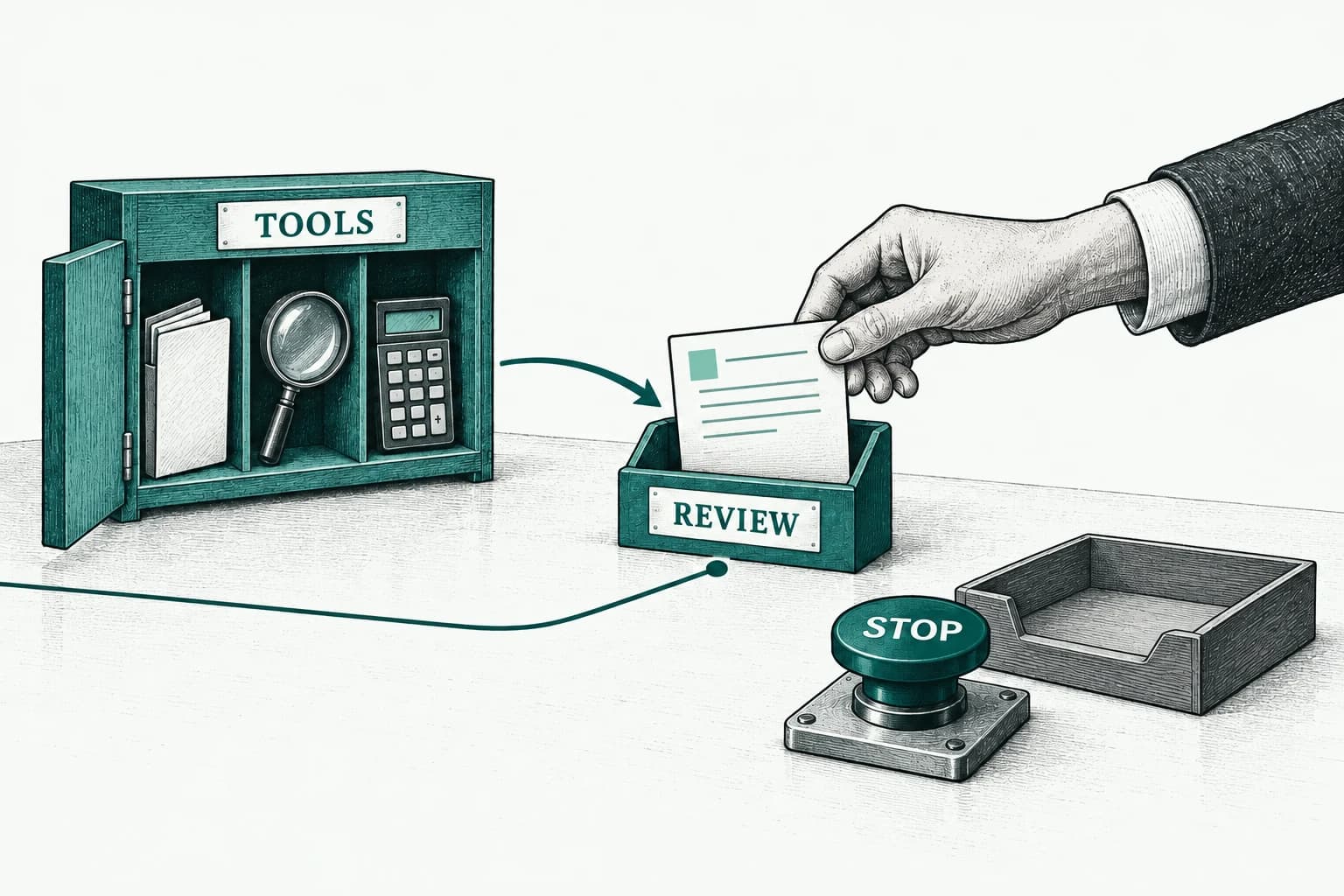
Give the agent the least privilege for the shortest duration. Separate read, draft, propose, and execute. Use scoped service accounts, allowlists, transaction limits, environment boundaries, and approval tokens rather than sharing a powerful employee credential. Restrict which records, folders, customers, projects, and actions are reachable. Log every tool call and bind execution to an authenticated business context.
Treat retrieved content as untrusted. A web page, email, document, or ticket can contain instructions designed to manipulate the model. The agent should distinguish system policy from data, validate parameters, and never reveal secrets or change goals because a document asks. High-risk tools should use deterministic validation and human confirmation that displays the actual action, destination, amount, or message—not a vague summary generated by the same model.
Keep humans at real decision points
Human-in-the-loop only works when the reviewer has time, authority, and evidence to disagree. Define what must be checked and show the source beside the proposed action. For a customer response, display the relevant account facts and policy; for a purchase, show supplier, item, amount, budget, and terms; for a system change, show the exact diff and test result. Do not ask a person to approve hundreds of opaque actions until clicking becomes automatic.
Escalation should be a successful outcome, not agent failure. Route ambiguity, low confidence, conflicting sources, sensitive data, policy exceptions, and high impact to an owner. Preserve the conversation and tool evidence, while minimizing personal data. Set stop conditions for repeated failure, unexpected cost, unavailable dependencies, instruction conflict, or suspected compromise. A safe agent knows when it is outside its assignment.
Evaluate behavior before granting action
Build a representative evaluation set with normal, rare, adversarial, multilingual, incomplete, and contradictory cases from permitted data. Define expected actions and prohibited actions. Measure task completion, factual support, tool selection, parameter accuracy, policy compliance, escalation quality, latency, cost, and reviewer correction. Test prompt injection, excessive tool calls, duplicate actions, stale data, permission denial, outage, and recovery.
Run offline, then in shadow mode, then with a small user group and reversible actions. Compare output with the prior process and investigate both agent and human errors. Do not promote solely because a demonstration worked. Retest after model, prompt, tool, connector, policy, data, or workflow changes. The NIST AI RMF’s Govern, Map, Measure, and Manage functions provide a useful structure for recording this lifecycle.
Monitor operations, cost, and incidents
Track outcomes rather than only model responses: completed work, corrections, escalations, duplicate or blocked actions, customer effects, security events, latency, and end-to-end cost. Monitor token and tool consumption, but include reviewer time, integration, evaluation, support, observability, and failures. Unexpected action volume may indicate a loop or abuse. Rate limits, budgets, and circuit breakers should prevent a small error from scaling.
Prepare an incident path to disable tools, revoke credentials, preserve logs, identify affected records, reverse permitted actions, notify owners, and communicate with users. Maintain a manual process for critical work. Review near misses and recurring overrides. An agent that is repeatedly corrected on the same category needs changed data, policy, prompting, routing, or scope—not more trust.
Scale a portfolio, not a collection of experiments
Maintain a register of agent workflows with owner, objective, data, tools, risk tier, users, model and provider, evaluation, approvals, metrics, incidents, and review date. Retire unused tokens and connectors. Standardize identity, logging, approval, secrets, evaluation, and deployment infrastructure so each use case does not invent its own controls. Keep authoritative records in business systems rather than opaque agent memory.
Review value quarterly and stop weak uses. A useful agent should reduce meaningful friction, improve service or control, or create capacity for higher-value work. It should not merely produce more drafts, messages, or dashboards. Expand autonomy one permission at a time and retain a rollback. For an SME, disciplined narrow systems can deliver more dependable value than an ambitious autonomous design with unclear accountability.
Design memory deliberately. Decide which facts belong in an authoritative business system, which temporary context may be retained for a task, and which information must not persist. Let users see and correct relevant state. Apply access and tenant boundaries to retrieval as well as storage. An agent that remembers an old instruction, customer detail, or exception without provenance can act confidently on stale or inappropriate context.
Treat external communication as a separate permission. A draft visible to an employee is different from an email sent to a customer, a social post, or a commitment made to a supplier. Require approved templates, audience checks, source support, and explicit confirmation. Monitor bounces, complaints, and corrections. Rate limits should prevent one erroneous workflow from contacting a large audience before detection.
Plan responsibility across vendors. A model provider, agent platform, connector, and SaaS system may each control part of the path, but the SME still owns the business outcome. Document support and incident routes, version dependencies, service levels, data processing, and exit. Preserve configurations and business records in exportable forms. Test the manual alternative during normal operations, not for the first time during an outage.
Involve workers and users early. Explain the task boundary, how performance is measured, which decisions remain human, and how people can challenge output or report harm. Avoid covert monitoring or using productivity traces for a new purpose without assessment. People closest to the workflow often identify exceptions a demonstration missed. Their feedback is evidence for redesign, not resistance to automation.
Keep customer and regulator representations accurate. Do not advertise full autonomy, perfect accuracy, or human equivalence. Explain material AI involvement and available recourse where context or law requires it. If a person can appeal or correct an outcome, make the route usable and preserve the facts needed for review. Honest boundaries protect trust and help sales teams describe the product consistently.
Before each expansion, ask what new failure becomes possible. More records increase privacy exposure; a write tool introduces integrity risk; external messaging creates reputational risk; money movement creates fraud and loss; multiple agents create delegation ambiguity. Update the threat model and evaluation for the new permission. Prior success at a lower level is evidence, not automatic authorization for the next one.
Record that decision and its accountable approver.
| Level | Agent capability | Required evidence before expansion |
|---|---|---|
| Observe | Read approved, scoped data | Access review, privacy assessment, retrieval accuracy |
| Draft | Prepare content or proposed records | Quality evaluation, source support, reviewer workflow |
| Recommend | Select an option with rationale | Decision tests, bias and error analysis, escalation |
| Act with approval | Execute the exact confirmed action | Parameter display, authentication, logs, rollback |
| Bounded automation | Execute low-risk cases within strict rules | Sustained results, monitoring, limits, incident readiness |
Frequently asked questions
Does an AI agent need access to every business system?
No. Broad access increases risk and rarely improves a narrow workflow. Give scoped read access first, add one tool at a time, and require separate approval and credentials for consequential actions.
Can an AI agent replace a role in an SME?
Plan around tasks and decisions, not a claim that software replaces a person. Work includes accountability, relationships, exceptions, ethics, and context. Measure which tasks improve and redesign responsibilities with employees transparently.
What is the safest first AI-agent use case?
Choose a permitted, internal, read-only or draft-only workflow with visible inputs, easy verification, low consequence, and a clear baseline—such as assembling an approved information brief for human review.
Sources
- Artificial Intelligence Risk Management Framework — National Institute of Standards and Technology
- Artificial Intelligence Risk Management Framework: Generative AI Profile — National Institute of Standards and Technology
- Introducing the Model Context Protocol — Anthropic